Barbeau Observatory
Good Morning, MidnightBarbeau Observatory is a remote Arctic outpost whose imposing telescope and continuing flow of astronomical data stand in stark contrast to the human world falling silent around it. Built into a mountain and positioned at the edge of civilization, it first serves as a scientific workplace; after an evacuation, it becomes the refuge Augustine refuses to leave and the shared home he makes with Iris. Its isolation gives physical form to the novel’s central tension between a universe still transmitting signals and an Earth from which no answer comes.
Setting and Design
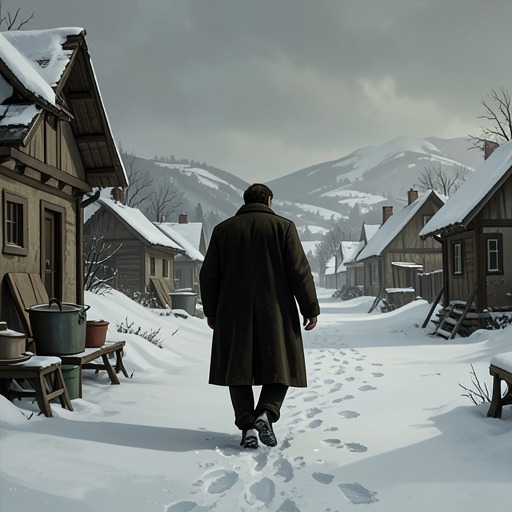
Barbeau Observatory was built as an extension of the mountain. Its telescope dome rose above the surrounding range, a blunt, conspicuous structure that seemed to survey the landscape. About a kilometer south stood an airstrip and hangar. The strip had been cleared from the tundra with a bulldozer brought from Greenland, then marked with reflective orange flags and lights that no longer worked. By the time Augustine remained there alone with Iris, the hangar was empty and the runway neglected. The last planes had come to collect the researchers, and the last news they brought from civilization, more than a year earlier, had been of war.
The outpost had been provisioned for a dozen researchers for nine months. Its stores included fuel, nonperishable food, purified water, medical supplies, firearms, fishing gear, skis, crampons, and climbing ropes. The observatory stood at the center of scattered dormitories, storage units, and recreation buildings; its substantial structure was more permanent than the weatherproof tent-like outbuildings around it. The telescope was the reason the rest of the base existed. It supplied Augustine with more equipment and incoming data than he could use or process, even as the surrounding facilities depended on supplies and transport from beyond the Arctic.
Evacuation and Isolation
Barbeau’s standard research fellowship lasted six to nine months. Augustine had already stayed for almost two years before the evacuation and remained for nearly three years in all. He had little affection for the young researchers who usually came through the program, regarding them as overly theoretical and poorly equipped for practical life. His contempt for them matched a broader habit of holding others at a distance; the outpost’s remoteness allowed him to continue his work without needing to belong to a close community.
When the Air Force arrived to take the researchers away, the captain assembled them in the director’s office, read their names, and explained when and how to board the aircraft waiting on the runway. Augustine chose not to go. He had come to the Arctic for the work and did not want to abandon the observatory, even as the evacuation implied a danger beyond the station. After the other researchers left, a young girl, Iris, remained behind. Augustine initially assumed someone would return for her, but no one did.
The following day Augustine tried to contact the Alert military base, the northernmost year-round settlement on Ellesmere Island. He received no answer. He scanned other frequencies, including amateur, emergency, and military aviation channels, and found only static. The silence made the observatory’s isolation more than a matter of distance: the communications networks that might have connected it to other people appeared to have disappeared. Augustine tried to explain the failure as a glitch or a storm and planned to try again, but the unanswered radios became an enduring condition of life at the outpost.
A Shared Home
The observatory’s control building gradually changed from a worksite into a shelter. To conserve fuel, Augustine heated only the top floor, where he kept his prized instruments and where he and Iris slept. The room held two induction hot plates, a kettle, a small collection of cookware and dishes, and a makeshift nest of sleeping bags and uneven mattresses. Reaching it was increasingly difficult for Augustine: he had to rest on the stairs, and he noticed that opening the heavy steel door took more effort than it had the year before.
The hooks along the wall held his layers of winter clothing, each mitten on its own peg. The abundance of hooks for a single person made the room seem less empty, as though the spread of clothing could mark out a human presence against the surrounding loneliness. Iris was often difficult to see because she scarcely moved or spoke. Sometimes she hummed melodies of her own; Augustine listened for the small signs of her presence, including her breathing. Their domestic life remained spare, but her quiet company became part of the observatory’s daily environment.
Augustine and Iris moved useful supplies into the heated upper floor piece by piece. He hauled mattresses up the stairs, while Iris followed with a crate of cooking utensils. Together they brought up food, bottled water, generator fuel, and batteries from the abandoned dormitories. The work made the observatory less a remote institution than a home they were assembling within it. Iris’s ability to carry her share also altered Augustine’s perception of her: she was not simply a silent presence he had to feed and supervise, but a capable companion in keeping their small household going.
Work, Signals, and Silence
After the evacuation, Augustine continued maintaining the telescope, its data archive, and the records of the sky. At first, the work seemed more important than ever: observation and cataloging gave him a structure to hold against the possibility that civilization had ended. Yet he also recognized that the catastrophe might erase the significance he had attached to his life’s work. The world outside the observatory was silent, while data from outer space continued to arrive. He eventually accepted the futility he felt and found a calmer routine in the telescope’s upkeep and the steady presence of Iris.
The observatory’s setting makes that contrast tangible. The Arctic day returned only gradually after polar night, with a few hours of light at a time, before the midnight sun would rise and the stars fade. Augustine watched the low sun through cloud and mountain silhouettes, aware that the seasonal cycles would continue even as human contact failed. In the darkness, the observatory’s equipment and its incoming data provided an activity that could continue without any certainty about who, if anyone, would receive its results.
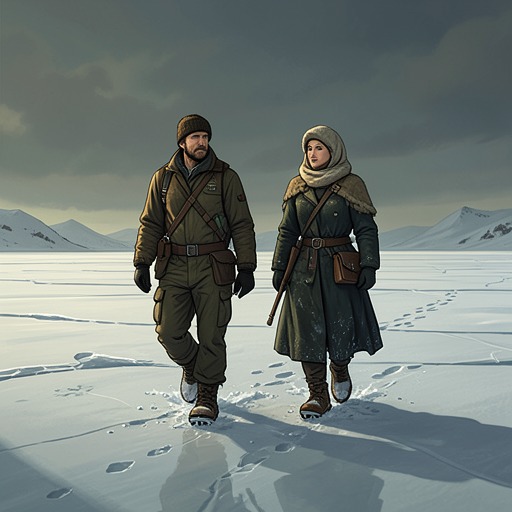
Augustine also turned the outpost’s communications equipment outward. He transmitted a call for anyone listening, identifying his amateur-radio call sign and asking whether anyone was there. Later, after the story had moved beyond Barbeau, a radio shed by a frozen lake offered a striking echo of that attempt: winter silence made the receiver’s static a relief, until a faint voice emerged and, after repeated calls, a woman answered. The two locations are not interchangeable; rather, the later exchange sharpens the significance of Augustine’s earlier transmission from the observatory. A call can cross the silence, but its answer depends on another person being alive and able to respond.
Narrative Significance
Barbeau Observatory is both a scientific instrument and a place of human enclosure. Its telescope opens Augustine’s attention toward the immense, while the heated third floor narrows his world to a room shared with Iris. This contrast gives the setting its emotional force: the station can continue collecting information about the universe, but it cannot explain the crisis on Earth or restore the human community that has vanished from its radios.
The observatory also changes without ceasing to be itself. Its dome, research equipment, and incoming data remain, but the evacuated dormitories and neglected airstrip expose how dependent the outpost was on the wider world. Augustine’s refusal to leave first appears as a decision to preserve his work; the silence that follows makes staying a confrontation with isolation, uncertainty, and responsibility for Iris. The station becomes their provisional home not through comfort or abundance, but through repeated acts of maintenance, carrying, listening, and sharing space. Its remote position thus turns the novel’s largest questions into ordinary routines: keeping the instruments running, searching the frequencies, and making room for another person.